Why choose Lithium-Titanate (LTO)?
What is Lithium-Titanate (LTO) technology?
Lithium-Titanate (LTO) is a specialized lithium-ion battery chemistry in which the anode is composed of lithium-titanate (Li4Ti5O12) rather than conventional graphite. This unique material provides exceptional structural stability, enabling extremely safe operation, rapid charging, and an unparalleled cycle life. LTO technology is widely used in demanding applications such as electric transportation, grid-scale energy storage, and industrial or medical equipment where reliability and durability are paramount.
Advantages of LTO Batteries
LTO is used instead of carbon materials like graphite as the anode active material due to a variety of reasons including:
High Intercalation Potential
LTO has a higher lithium intercalation potential than graphite, which significantly reduces the risk of lithium plating. This enhances overall safety, especially during high-current fast charging.
Outstanding Rate Capability
The LTO anode supports exceptionally high charge and discharge currents (often exceeding 10C continuous discharge) without degrading the cell. This allows for ultra-fast charging—reaching 80% capacity in minutes—and stable high-power output.
Zero Strain Material
Lithium-titanate maintains its crystal structure during cycling, experiencing virtually no volume change. This “zero-strain” behavior minimizes internal mechanical stress, which is the primary cause of degradation in other lithium chemistries.
Exceptional Cycle Stability:
Because the anode remains structurally intact, LTO cells can endure 20,000 to 30,000+ charge cycles with minimal capacity loss. This makes them the most cost-effective solution for long-term, high-frequency use.
Superior Low-Temperature Performance:
Unlike graphite anodes, LTO maintains a high lithium-ion diffusion rate even in extreme cold. These cells can often retain up to 80% of their capacity at -30°C, making them ideal for harsh environments.
Great Safety
LTO chemistry is significantly safer than conventional Li-ion systems. The thermal stability of the titanate structure greatly reduces the risk of thermal runaway, even under physical damage or extreme electrical overstress.
Why LTO is Significantly Safer than Conventional Lithium-Ion?
The primary reason for LTO's superior safety profile lies in replacing the graphite anode with Lithium-Titanium-Oxide. This shift in chemistry fundamentally changes how the battery behaves under stress, resulting in four critical safety advantages:
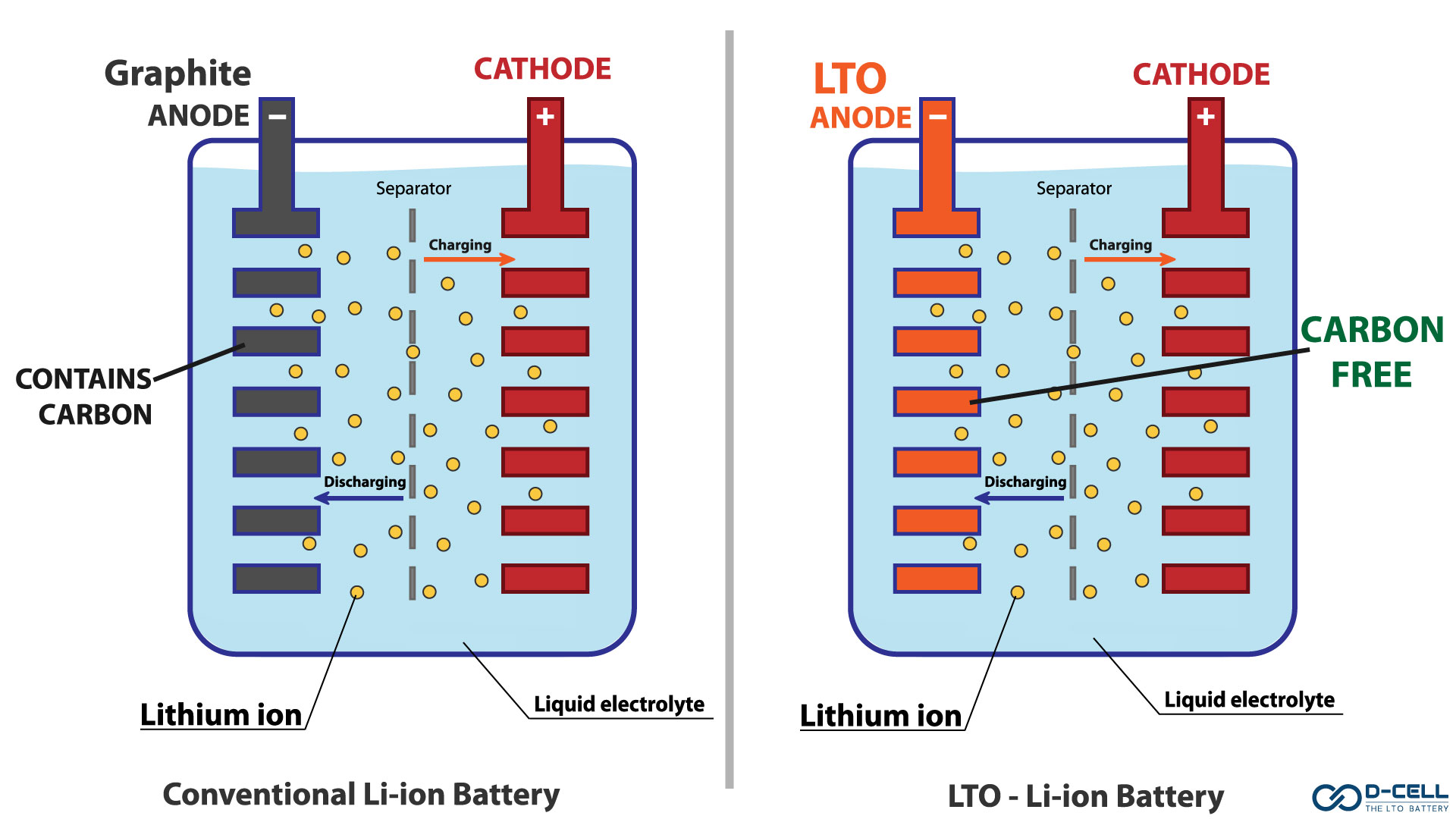
By using lithium-titanium-oxide in the anode, we achieve a number of positive characteristics, which apart from making it possible to build compact and durable systems, also have implications for battery safety. These are:
No dendrite build-up and no risk of ruptured separator
Zero-strain material (virtually no volume changes during cycles)
Ultra-fast charging and exceptional low-temperature performance
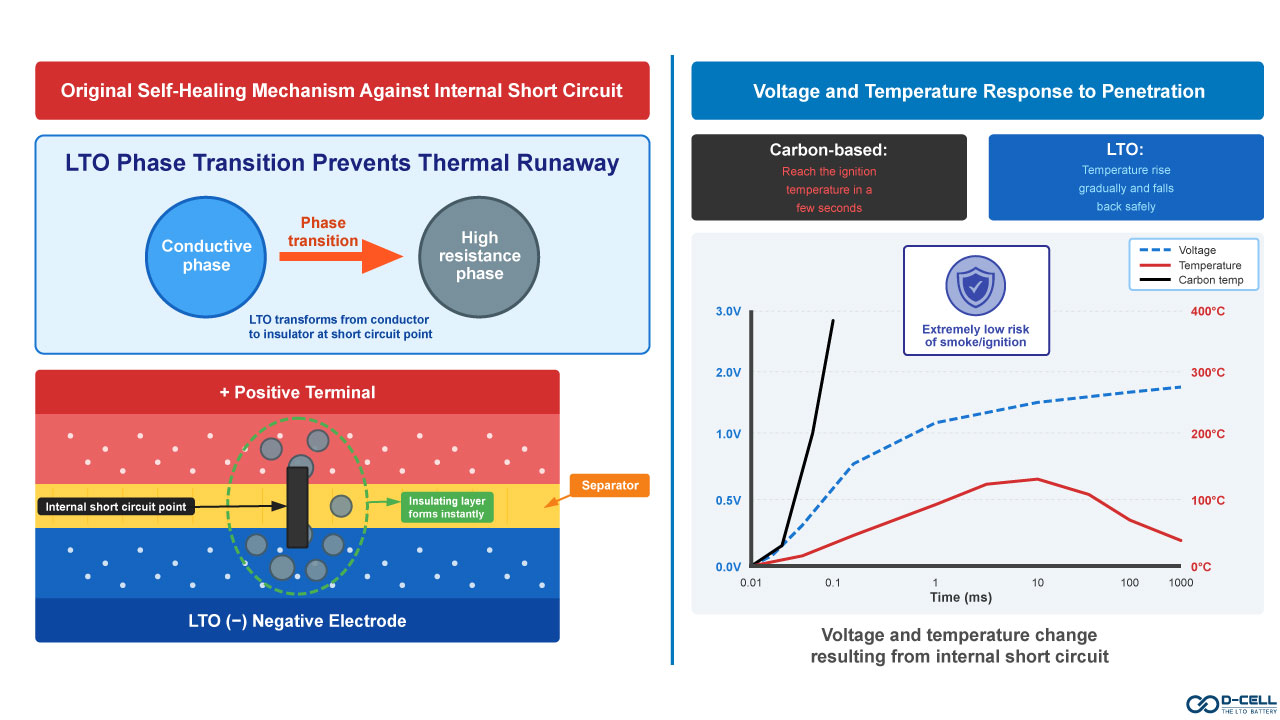
Inherent self-healing mechanism that prevents short circuits
Let's explore these advantages in detail
Prevention of Dendrite Formation
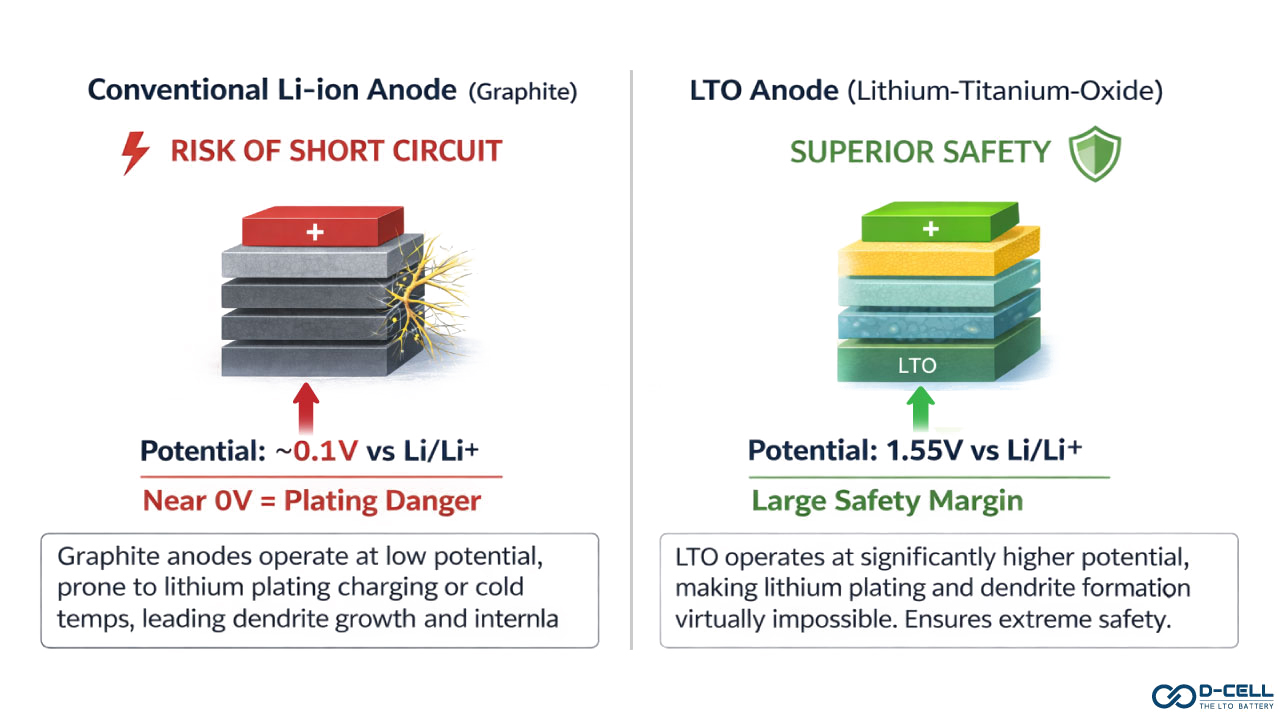
In conventional lithium-ion batteries (like NMC or LFP), dendrites are a major safety risk. These are microscopic, needle-like metallic lithium structures that grow slowly on the anode. Eventually, they can pierce the separator, causing undetectable internal short circuits and thermal runaway.
Standard batteries use graphite anodes where lithium insertion happens at roughly 0.1V vs. Li/Li+. Rapid charging or cold temperatures can easily drop this potential to 0V, triggering lithium plating. In contrast, LTO operates at a much safer 1.55V. This wide margin makes it physically nearly impossible for dendrites to form, ensuring safety even under extreme charging conditions.
Zero-Strain Material (Structural Integrity)
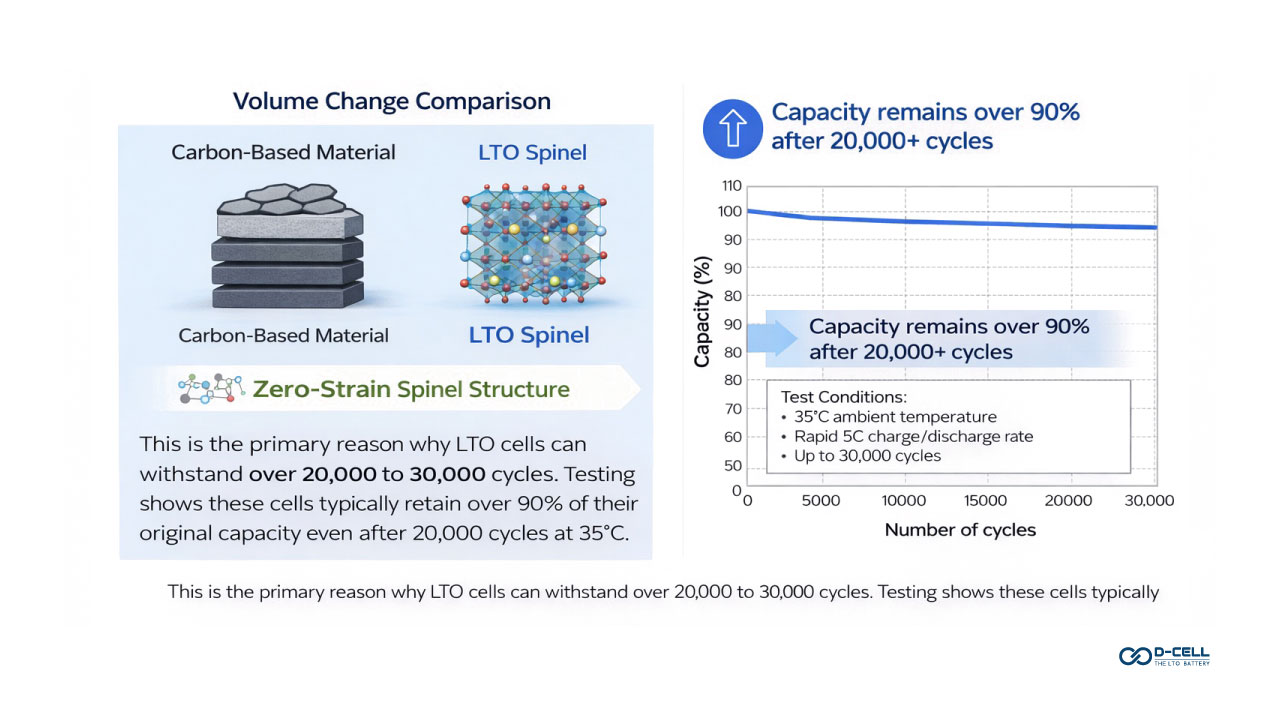
Most battery chemistries experience 5-15% volume change during charge and discharge, causing mechanical stress that degrades the battery over time. LTO features a spinel structure, often called a ''zero-strain'' material, because it undergoes virtually no volume change.
This is the primary reason why LTO cells can withstand over 20,000 to 30,000 cycles. Testing shows that even after 20,000 cycles at 35°C, these cells typically retain over 90% of their original capacity.
Rapid Charging and Low-Temperature Resilience
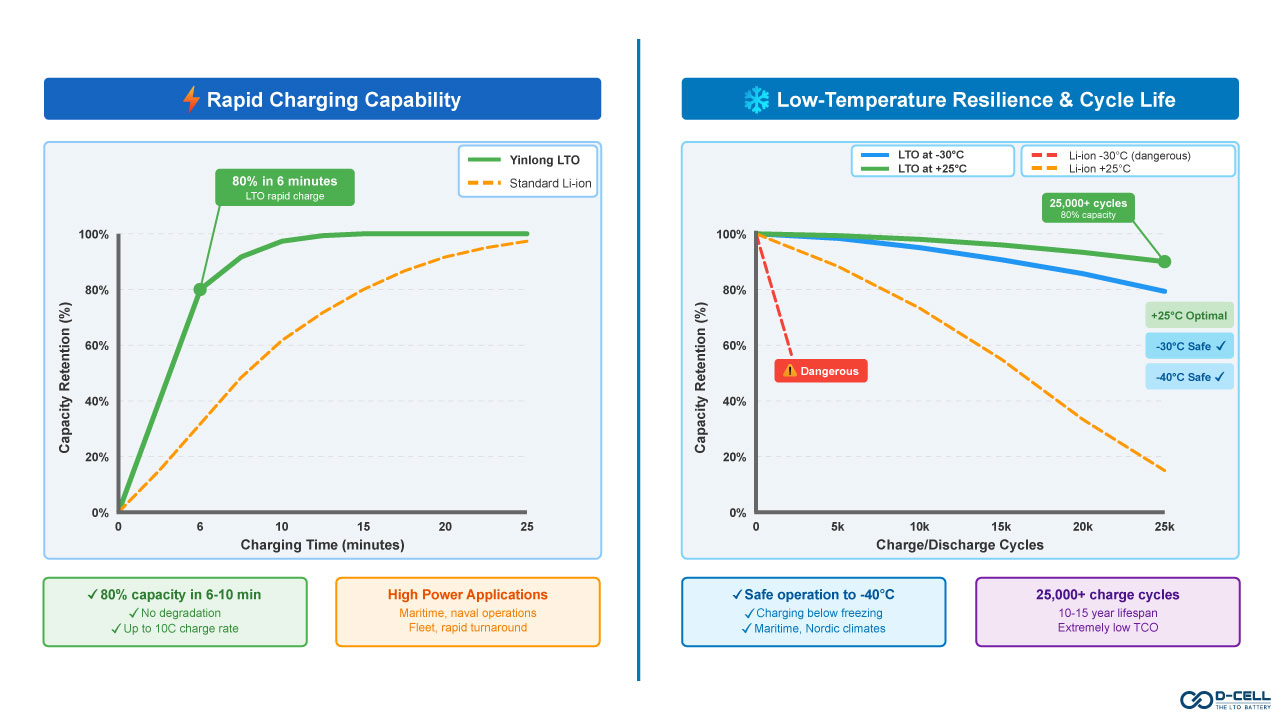
LTO is the ultimate choice for applications requiring high power and speed. A cell can be charged to 80% capacity in as little as 6-10 minutes without risking the degradation associated with fast-charging other chemistries.
Furthermore, the unique anode chemistry remains stable in extreme cold. While standard Li-ion batteries can be dangerous to charge below freezing, LTO maintains safe operation down to -30°C or even -40°C, making it ideal for maritime, naval, and Nordic applications.
Self-Healing Mechanism Against Penetration
LTO batteries possess a unique ''self-healing'' property. If an object penetrates the cell (like a nail or a stray bullet in naval settings), the LTO material adjacent to the short circuit point immediately transforms from a conductor into an insulator.
By instantly creating this insulating layer, the battery chokes off the short-circuit current before it can escalate into a catastrophic thermal runaway event. This makes LTO one of the few chemistries that can truly survive physical penetration without exploding.
LTO vs LiFePO₄ - Technology Comparison
Both Lithium-Titanate (LTO) and LiFePO₄ are safe lithium battery technologies, but they are optimized for very different priorities.
| Feature | LTO (Lithium-Titanate) | LiFePO₄ |
|---|---|---|
| Charging speed | Ultra-fast charging and discharging 10-15 minutes | 2-4 hours |
| Cycle life | 30,000+ cycles | 2,000-5,000 cycles |
| Operating temperature | -40 °C to +60 °C | -20 °C to +50 °C |
| Safety | Extremely high | High |
| Energy density | Lower (50-80 Wh/kg) | Higher (90-160 Wh/kg) |
| Upfront cost | Higher | Lower |
| Best use case | High-cycle, extreme, critical systems | Weight- and cost-sensitive systems |
Talk to us.
Power up your project.
Whether you're looking for high-performance LTO solutions for industrial use or need a custom energy storage system — our experts are here to help you find the perfect cell for your needs.
Free technical consultation for industrial partners
Wholesale pricing for bulk LTO orders
Detailed datasheets provided within 24 hours